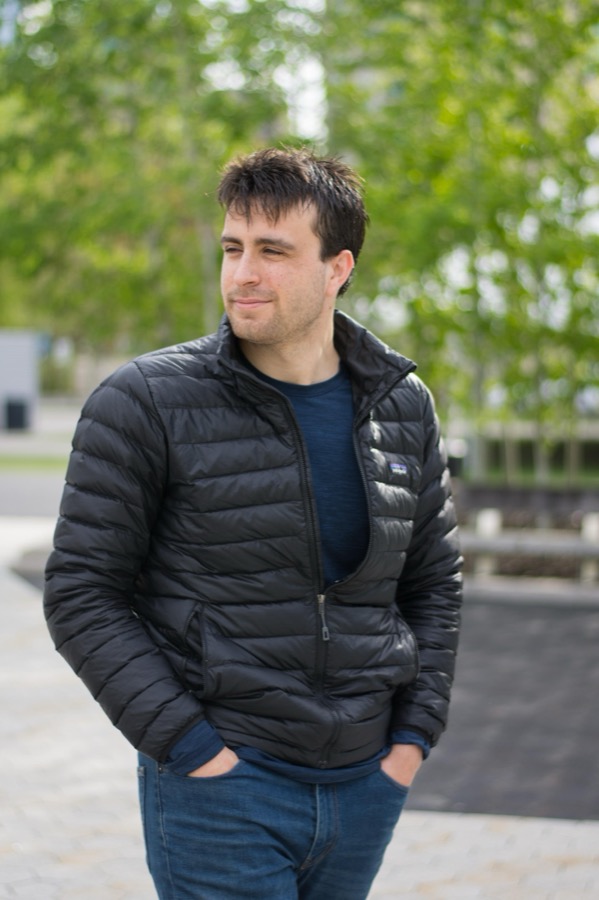
Wear what you would wear on a first date. That is the short answer, and it is the advice Talib gives clients most often, because what to wear is the question clients ask most before a shoot.
Aim for a better version of your real life: clothes that fit well, that you already feel like yourself in, and that sit between a suit and sweatpants. The rest of this guide covers what that looks like in practice, what to avoid, and how outfit changes work across a session.
The rule: a first-date outfit
Picture the outfit you would pick for a first date with someone you are excited to meet. It is neat, it is comfortable, and it says you made an effort without trying to impress anyone with the clothes themselves. That is the target for your photos too.
Two extremes cause most of the problems:
- Too formal. A suit and tie reads as a work headshot. It makes the photo look stiff and can make you feel stiff, which shows in your face and shoulders.
- Too casual. Sweats and worn-out T-shirts look like you did not think about the photo at all.
The middle is wide, and most people already own something in it.
Fit matters more than formality
Across recent style guides for online dating, one point comes up again and again: a well-fitted smart casual outfit beats both boxy clothes and dressing up. These guides are opinion rather than data, but the idea holds up in front of a camera. Clothing that is too loose hides your shape and adds bulk. Clothing that is too tight pulls and wrinkles when you move.
Before the session, try each outfit on and move around in it. Raise your arms, sit down, and turn to look over your shoulder. If something pulls, rides up, or needs constant adjusting, leave it at home.
Good starting points
If you are unsure where to begin, these are common safe choices:
- A fitted henley or crew-neck knit.
- A clean button-down shirt, with or without a layer over it.
- Dark jeans or chinos.
- A simple fitted top with straight or wide-leg trousers.
- Clean sneakers, or Chelsea or ankle boots.
None of this is a uniform. Treat it as a menu, and pick the items that match how you actually dress.
Avoid peacocking
Talib's advice is to avoid peacocking: loud statement pieces, heavy branding, or anything that draws the eye to the clothes before the face. The photo is there to show a person, and an outfit that competes with you works against that.
This does not mean everything has to be plain. A well-chosen colour or a good jacket is fine. The test is simple: if a stranger would remember the outfit more than you, change it.
Colour and background
Solid colours that contrast with the background tend to stand out. In practice, that means checking the setting before you choose. A navy shirt disappears against a dark brick wall, and a white shirt can wash out against bright snow or pale stone. Busy patterns and large logos tend to pull attention away from your face.
One older data point is worth knowing, with the right caveats. A Tinder study of 12,000 profile photos from around 2016, covering New York, Los Angeles, and Atlanta, found that black was the most common clothing colour, worn by about 30.6% of women and 32.3% of men. It counted what people wore. It did not show that any colour gets more likes, so use it as a reminder that black is common, not that it is wrong. The report is covered by Bustle.
Talib's own advice to clients is solids over prints, and darker colours tend to work best. Treat that as a guide rather than a rule: clothes that show your personality are welcome.
Change outfits across your photos
A profile with six photos in the same shirt feels thin. Different outfits across your set show range: a casual look, a slightly smarter one, maybe one with a jacket or an extra layer. Each should still look like you.
This is built into the packages. Basic includes 1–2 outfit changes, Premium includes 3–4, and Plus includes 6 or more. You can see the full details in the packages section. Bring a few options rather than a single outfit you are certain about, and decide on the day with Talib which ones work best.
Why the length of the session matters
Premium is the package clients book most often, and Talib's reasoning applies to outfits as well as poses. One hour allows a variety of shots and lets you get comfortable in the studio. Getting good photos takes time: comfort comes first, and the strongest shots tend to come later in the process, once you have stopped thinking about the camera.
That is also why a second or third outfit is useful. By then you have relaxed, so the later looks often feel more natural than the first.
A short checklist for the night before
- Pick three or four outfits that fit well and feel like you.
- Try each on and move around in it.
- Check that nothing is wrinkled, faded, or pilled.
- Choose a mix: one casual, one slightly smarter, and one with a layer if you can.
- Pack shoes that suit each outfit.
Clothes should look like a better version of real life
The goal is not a costume. Someone who matches with you will eventually meet you, and the photos should set the right expectation. Clothes that look like a better version of your real wardrobe do that. They also tend to make you more relaxed on the day, which is what makes the photos look natural.
If you want to see how the rest of a session works, our guide to natural poses for dating photos covers how to stand and move once the outfit is sorted. And if you are still deciding on a studio, the cost guide explains what each package includes.
Talib also advises on outfits after you book, so you do not need to have it all worked out in advance.